

How to understand an administrative drift at the Société des Traversiers du Québec (STQ) and the Québec Ministry of Transport (MTQ)

The cost of the two large new ferries and wharf facilities at Tadoussac has already caused a great deal of ink to flow. Over 18 years, the volunteer citizens of the Société du Pont sur le Saguenay à Tadoussac (SPST) have gathered a good deal of information on this subject from the MTQ and the STQ, and we present here these documents and our understanding of this dizzying rise in the cost of the ferries. We are aware that many questions will remain without official answers since, for the users of the Tadoussac ferry service, this decision by the Société des Traversiers is unjustifiable — and indeed unjustified by the engineers of the Société des Traversiers as well as those of the Ministry of Transport. Here first are a few questions likely to guide the research of the Auditor General of Québec, who has been asked to rule on the cost explosion. Unfortunately, no one has asked to understand what justified the construction of these ferries. We offer some answers. Let us start with questions of interest to the Auditor General.
Questions for the Auditor General
- Why, in 12 years between July 2006 and 2018, while the cost of living in Canada rose by 22%, did the replacement cost of the Tadoussac ferries explode from $27M each to $162M each, with along the way a 50% increase in the number of vehicles, a decrease in crossing frequencies and an increase in the risks of accidents related to the ferry syndrome? In terms of costs, this is a 600% increase over the first assessment made by the STQ in 2006.
- Why was the STQ suddenly seized with a desire to replace the ferries at Tadoussac in September 2009, when 3 weeks earlier it had confirmed, in the Impact Study on the Tadoussac Bridge published in August 2009, that the current vessels were in good condition and that it planned to keep them at Tadoussac until the end of their useful life in 2025?
- Why is the STQ replacing, in high season, 3 ferries of about 73 car-equivalents each with 2 ferries of 110 car-equivalents, and asserting before the BAPE that service will be improved at peak times, knowing that these periods occur mainly in summer and that the current frequency of every 13 minutes with boats of an average capacity of 73 vehicles will be reduced to every 20 minutes with the 110-vehicle boats? Yet the 3 current boats are able to carry more vehicles per hour to absorb the long queues than the two new ferries.
- Knowing that the new large vessels will perform less well at peak times, why this urgency to replace the ferries when its CEO recently stated that upgrading work on the current Tadoussac ferries, first estimated at $8M and then revised to $39M, would extend their useful life by 25 years?
- Where are the serious analyses underpinning this assertion, knowing that these vessels have been subjected to heavy use day and night for nearly 40 years in particularly difficult navigation conditions, with high-frequency stops and starts through strong currents and ice, among other things?
- Why does the STQ systematically underestimate the reconstruction prices of the current ferries when it addresses the government to carry out projects, or when the authors of an impact study on the construction of a bridge to replace the ferries at Tadoussac question it to find out the fair reconstruction price?
- Why did no prior analysis, no study, no consultation of users or of the community take place before a decision of this importance was made?
- Why were citizens prevented from addressing the question of the bridge versus the ferries because of the limited mandate of the BAPE on the construction of a mooring dolphin at the Tadoussac lay-by wharf?
So many questions that will allow a better understanding of the basis on which public funds are spent at the Société des Traversiers du Québec.
An elastic contract and pampered lenders…
We are aware that any discussion of Davie Shipbuilding is very delicate to raise in Québec City. However, a Globe and Mail investigation published on the front page of the April 29 edition (see the article) lifts the veil on part of the cause of this phenomenal growth in the costs of the Tadoussac ferries. The reasons put forward by the company, to the effect that the STQ added requests, may not be the most accurate explanation. Among other things, the Globe investigation tells us that the company is borrowing hundreds of millions to build the two Tadoussac ferries, at interest rates of up to 25% annually, on the pretext that banks will not lend to it because of its weak solvency. As taxpayers, should we not question the type of contract signed by the STQ? An elastic contract, without a fixed price, awarded by direct agreement — an “open bar”, so to speak — when nothing justifies guarantees not having been given. The Québec government is very solvent and could easily have borrowed at an interest rate 5 times lower. Moreover, the disputes with the Société des Traversiers and the stoppage of work for many months raise questions as to who benefited from these delays. If you lend money to a borrower at 25% or 19% annual compound interest, would you not be happy to learn that the pleasure will last a few additional years, knowing moreover that the client (the STQ or the Québec government) offers every guarantee of solvency?
Owners in tax havens?
Considering that it is impossible to know who the owners of Davie are, some of them being in tax havens, can one imagine that certain lenders are linked to the phantom owners and that they had an interest in prolonging the work and the legal conflicts (K83–K84) while compound interest at near-usurious rates accumulated from 2013 onwards? Davie’s ownership being a mystery, every hypothesis can be considered. For example, are the former Premier or his former colleague, then CEO of the STQ — who alone, without any consultation or prior analysis (as confirmed at the BAPE hearings in Tadoussac on November 8, 2016, BAPE File 334, Document Dt1 p. 24, lines 923 to 925), made the decision to build these boats — owners of or associated with one of the numbered companies in tax havens cited in the Globe investigation? Are the high-rate lenders or the Davie executives interested in one of these phantom owner companies? Who knows, apart from the bankers of these havens and the players?
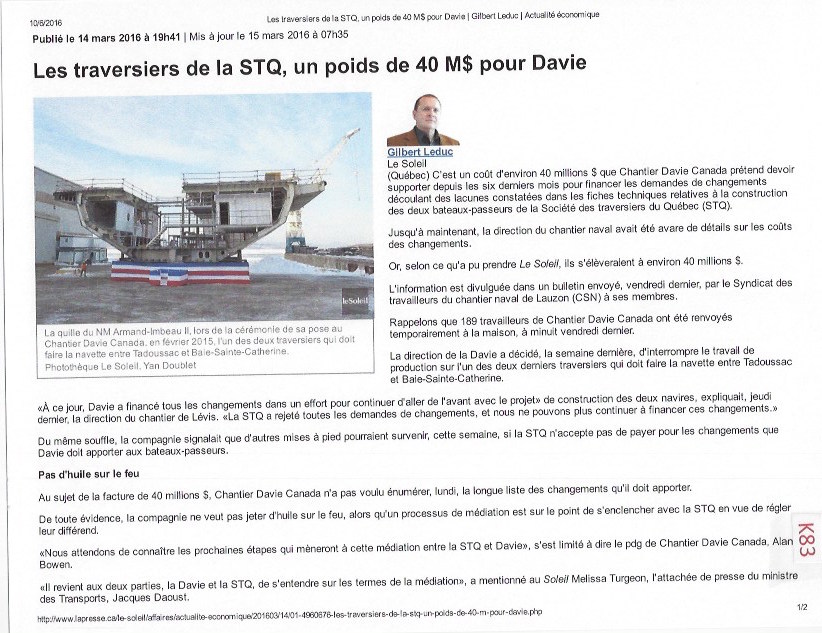
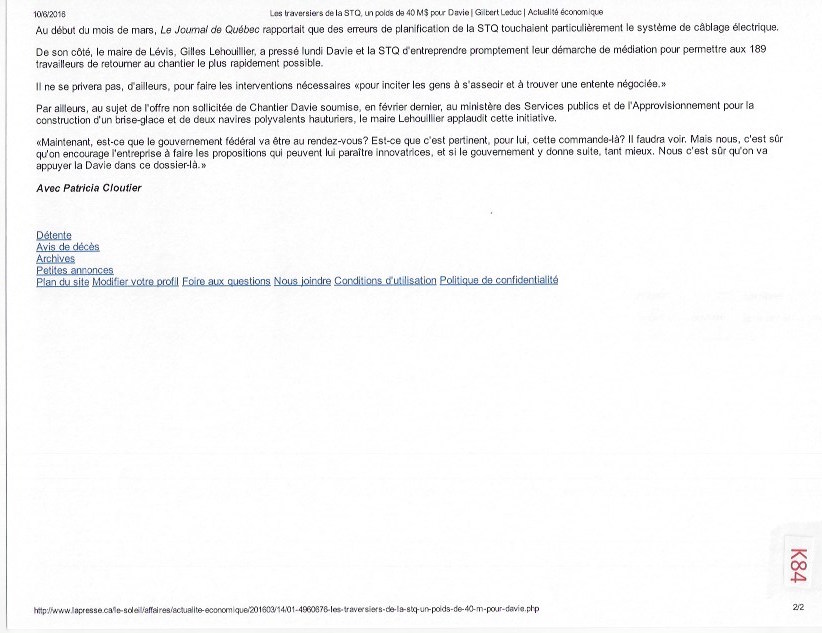
Recall that the construction of the Tadoussac ferries was announced by Minister MacMillan in September 2009 and the boats were to be delivered in 2013. Davie went bankrupt again in the early 2010s, which delayed the signing of the contract. To better understand the reasons for the cost overruns, one must look at the Globe investigation. As an example, if the first $100M borrowed to start the work was at 25% annual compound interest, here is what taxpayers would have paid with accumulated interest by January 2018.
January 2013: $100M
January 2014: $125M
January 2015: $156M
January 2016: $195M
January 2017: $244M
January 2018: $305M
January 2019: The boats are expected to be delivered in 2018, but opinions differ as to the delivery dates.
On the first $100M borrowed, the interest cost is double the borrowed capital if the 25% interest rate is applied. The Globe investigation also reports loans at rates varying from 17 to 19%. Finally, discussions and negotiations with the Ministry of the Economy apparently attempted to limit the haemorrhage of public funds. This $200M in interest is pocketed by lenders located outside Québec, so no tax return on these gains for the province.
Is the argument of multiple additional requests by the STQ really the only explanation that could have almost tripled the cost of the boats?
In short!
Take the example of a citizen who wishes to have a house built and who, for reasons X, does business with a company known for decades for its recurring insolvency; are you going to ask it to build your house and finance it without limiting the interest rates, knowing that you do not know the real owners and that the banks will not lend to it — even though your solvency as a client is recognized and solid?
This story doesn’t hold up…
Taxpayers, like users of Route 138, will pay dearly for this decision if they do not react.
Already a few months after this inexplicable decision, on March 3, 2010, we met Deputy Premier Nathalie Normandeau to explain to her the incoherence of this decision and handed her an explanatory document — to her, but also to the dozen senior officials accompanying her (Appendix K24 to K28). No follow-up resulted. Recall that the decision was made on the quiet at the Premier’s Office during a meeting with Georges Farrah, then President of the Société des Traversiers du Québec.
Are we dealing with an ingenious scheme to appropriate taxpayers’ money? Moreover, both levels of government have heavily subsidized this company in the past, to the point where it was no longer politically acceptable to do so in the form of a subsidy. Has the Québec government, accompanied by the federal government through its participation via its infrastructure grant program, just provided a disguised additional subsidy of $204M to Davie, knowing that the tendered price for the two ferries was $120M and that the CEO of the STQ at the time told us that the ferries would be eligible for federal funds from the current infrastructure program?
A little history
For the information of those interested in the file, here is the record of the real costs of the current ferries at Tadoussac, as well as the evolution of the estimate of their replacement cost and, finally, the evolution of the costs of the proposed mega-ferries.
1) The two Tadoussac ferries, the Armand-Imbeau and the Jos-Deschênes, were built in 1979 at Marine Industries in Sorel and delivered in 1980 at a cost of $5M each (Appendix F52, preparatory technical study for the Côte-Nord Transport Plan, M. Ruel, Eng., MTQ 1997)

2) They had their mid-life refit in 1996 and 1997 (re-engining, modernization and capacity increase of 15 car-equivalents (from 60 to 75 car-eq.)) at a cost of $14M each. (Appendix F52)
3) In 1997, the MTQ assessed their planned replacement cost at the end of their useful life at $50M (Appendix F52)
4) In July 2006, the SNC-Lavalin/Génivar consortium (responsible for the Impact Study on the construction of a bridge at Tadoussac) asked the Société des Traversiers, through the MTQ, what the replacement cost of its 2 ferries at Tadoussac was. Answer: $27M each, and only in 2025, i.e. less than half the price assessed by the MTQ in 1997 adjusted for the cost of living. (Appendix F25, p. 5 of the MTQ letter dated October 31, 2007 addressed to the SPST as part of the Advisory Committee on the 2009 Impact Study.)
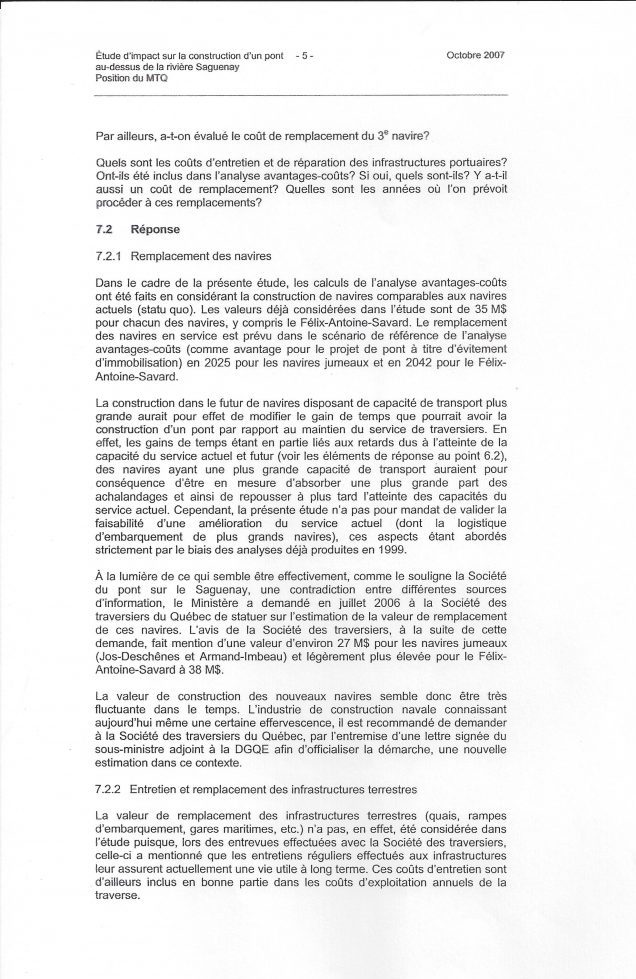
5) In 2006, the consortium assessed the replacement cost of the ferries at $35M in 2025 (Appendix F25)
6) In 2009, following representations by the SPST, including the presentation of the document appendix F52, the consortium set the replacement cost at $42M each in 2025 (Table F9 (a) of the Appendices to the socio-economic study of the Impact Study on the construction of a bridge at Tadoussac, available on the site www.pontsaguenay.com, under SNC-Lavalin/Génivar project)
In August 2009, the Minister for Transport, Mr. Norm MacMillan, made public the Impact Study on the construction of a bridge at Tadoussac.
This study concludes, following the cost-benefit analysis, that:
“The bridge solution, in the absence of any other relevant feasible solution, is therefore recommended from a long-term perspective of sustainable transport and sustainable development”. (Impact Study on the Tadoussac bridge, SNC-Lavalin/Génivar consortium, Socio-economic component, p. 5-18)
Recall that this study overestimated the cost of the bridge at nearly $900M, whereas the experts in the construction of such a bridge confirmed that its cost would be between $250M and $300M (Appendix G1 to G18), i.e. a cost equivalent to the construction cost of similar bridges elsewhere, including in Norway and Sweden. Likewise, the replacement costs of the ferries were underestimated by a factor of 3, or even 6 if one considers the Société des Traversiers’ assessment of July 2006: $27M × 6 = $162M.
Let us recall here that the Société des Traversiers provided these figures to enable the SNC-Lavalin/Génivar consortium to establish the cost-benefit analysis between the ferries and a bridge as part of the 2009 Impact Study.
It is understood from reading the study that the option of replacing the current ferries with larger ones is not “a relevant feasible solution”.
September 2009: Dramatic twist or panic?
Three weeks after the publication of the Impact Study on the bridge, in September 2009, the same minister, Mr. Norman MacMillan, announced the immediate construction, for delivery as early as 2013 (not at the end of the ferries’ useful life in 2025), of 2 large 110-space ferries (220 spaces) to replace the 3 current boats (75, 75 and 70 spaces, i.e. 220 spaces) serving the Tadoussac crossing. The new big boats at Tadoussac will cross every 20 minutes rather than every 13 minutes as at present in the busy season, hence a risk of increased waiting and, above all, the discharge of platoons increased by 50% at the exit of the boats (110 car-equivalents) onto a road without sufficient passing zones to dissolve the platoons of 75 vehicles currently discharged on arrival. Furthermore, the Côte-Nord and Labrador will remain isolated for another 45 years. Of course, no one among road users or the residents of the Côte-Nord and Charlevoix understood the STQ’s explanations.
An unjustified and unjustifiable decision
Moreover, at the BAPE hearings on the construction of a mooring dolphin (mooring post) at the Tadoussac lay-by wharf — the only opportunity offered to citizens to try to obtain answers concerning the justification for replacing three ferries still useful until 2025 with two large ferries — neither the MTQ nor the STQ could justify this decision other than by: it was a political decision that came “from above” (see File 334, Doc. DT1, pp. 24 to 27 and 49 to 56 and Document Dt2, pp. 4 to 6) — a decision unjustified and unjustifiable other than by incoherent interventions by the STQ to the effect that there would henceforth be 4 departures per hour, every 20 minutes (8:00, 8:20, 8:40 and 8:60). After a night’s reflection, the STQ noted that there are 3 departures every 20 minutes in an hour and therefore came back with a table in which departures are placed every 19 minutes. (Hearings of November 8, 2016, BAPE File 334, Document Dt1, pp. 101-102 and Document Dt2, pages 12 and 13 of the hearings of November 9, 2016)
Is $400M a reasonable price to pay to protect the 74 full-time jobs at the Tadoussac crossing, 40 of which are in Tadoussac itself? BAPE document File 334, Document Dq7.2
7) In 2009, announcement of the construction of 2 mega-ferries to replace the 3 current ones plus work on the landing stages. Costs: $170M, i.e. $120M for the two ferries, $20M for wharf works and $30M for new ramps; delivery date: 2013 (instead of 2025 previously — where does the urgency to replace come from? No answer to this question asked at the BAPE hearings — File 334, Doc Dt1, pp. 54 and 55). Estimated costs: $60M each
8) In 2013, announcement of an “extra of $2.5M per boat under construction” (appendix K43)

9) In 2015, announcement of a doubling of the wharf costs, from $20M to $40M (appendix K45)

10) In 2017, announcement by Minister Anglade that the boats will cost $125M each
11) In 2018, announcement by Minister Anglade that the boats will cost $162M each and will be delivered in June and September according to her, in the fall according to other sources, and within the next year according to others. (see https://www.ledroit.com/actualites/politique/explosion-du-cout-des-deux-traversiers-un-rapport-de-la-vg-apres-les-elections-c81e45ac6de69fe2642868877856729f?utm_source=dlvr.it&utm_medium=facebook).
Should the Auditor General not intervene upstream of decisions rather than downstream, when public funds of this magnitude ($400M) are spent?
No one, it seems, has the final figures for this fiasco. What we know is that, to date, a sum of $400M of taxpayers’ money is about to have been spent ($324M for the boats, $40M for the wharves, $30M for the ramps and $6M from the MTQ for the ferry waiting area at Baie-Sainte-Catherine). We also know that significant additional work will have to be undertaken by the Ministry of Transport to build the safe passing zones needed to dissolve the exit platoons, to adapt the Tadoussac hill, probably to extend the Tadoussac wharf, and to create a waiting area at Tadoussac — a project under discussion for 9 years now between the municipality of Tadoussac and the Ministry of Transport without any agreement having been reached to date. All this to maintain at all costs the isolation of the Côte-Nord and its dependence on ferry services.
A mooring dolphin at triple the price estimated by the STQ, even before construction begins…
Let us also recall that the CEO of the STQ stated during the budget review last week in the legislature that the mooring dolphin (additional anchoring post in the water) planned to extend the Tadoussac lay-by wharf has also seen its cost triple, from the price announced by the STQ of $1M at the BAPE hearings in Tadoussac on this subject (BAPE File 334, Doc DT1 p. 19) in November 2016, to $3M this week, during the review of the STQ’s appropriations. This amount may seem trivial, but it adds to the sum of underestimates made by the STQ in its boat construction and boat repair projects (the transfer of the 2 current boats to Sorel at a cost of first $6M then raised to $39M, without considering the wharf works there; the wharves at Matane–Baie-Comeau, at Tadoussac, etc., which more than doubled in price as estimated by the STQ; the Tadoussac boats from $27M to $60M to $162M).
When civil servants bamboozle the elected decision-makers…
How can an elected decision-maker make informed decisions when his civil servants provide him with biased and systematically underestimated figures in order to obtain the desired projects? A private company could never behave this way, since it must seek the best value for money to satisfy its client; the STQ seems to have unlimited access to public funds without anyone — not even the Minister of Transport responsible for the STQ — asking the elementary questions about these expenditures:
Where? When? How? Why? How much? For this project to build new ferries at Tadoussac? Had the question been asked at the right time, this fiasco would never have occurred, since it would quickly have been understood that such a decision was unjustified and unjustifiable.
Should the standard at the Société des Traversiers not be, as a matter of routine, to multiply their estimates by three in order to present acceptable and reasonable figures to elected officials?
How to get taken for a ride…
In short! North Shore residents and Québec taxpayers have literally been “taken for a ride on two big boats”, while the government has known since at least 2015 that a bridge would cost between $250M and $300M plus the approach roads. Bridges similar to the one required exist in Scandinavia, and their costs are known.
This decision to perpetuate the ferries is unjustifiable despite the surreal attempts of the STQ representatives to justify them at the BAPE hearings of November 8 and 9, 2016. (See BAPE File 334, Doc Dt1 pp. 101-102, and Doc Dt2 pp. 12 and 13)
To sum up: a bridge will cost $300M; no more operating and administrative costs, etc., which will exceed the current $15M annually; no more mid-life refits, reconstructions every 45 years, injuries and deaths attributable to the ferry syndrome, pollution from the boats — including the noise pollution that contributes to the disappearance of the St. Lawrence belugas (Radio-Canada’s Découverte program, March 4, 2018); no more road impasse preventing reliable access to the region.
The ferries cost $400M to date, plus operating, administrative and other costs every year. They will maintain the socio-economic alienation of the region for decades to come if North Shore residents swallow the poison pill concocted by the Société des Traversiers.
Common sense must be heard quickly — that is where the urgency lies: build a bridge!
*The appendices to which we refer in this document can be read in the “excerpts” column of the interactive table of studies under the studies tab of the site, as well as in the documentation on the BAPE site on File 334, the Public Hearings on the construction of a mooring dolphin at the Tadoussac lay-by wharf https://www.bape.gouv.qc.ca
Leave a Reply